Aug 5, 2026Buying Guides
How to Choose the Right Size Commercial Outdoor Umbrella
A practical guide to choosing commercial umbrella dimensions based on table size, seating layout, shade coverage, clearance, and project conditions.
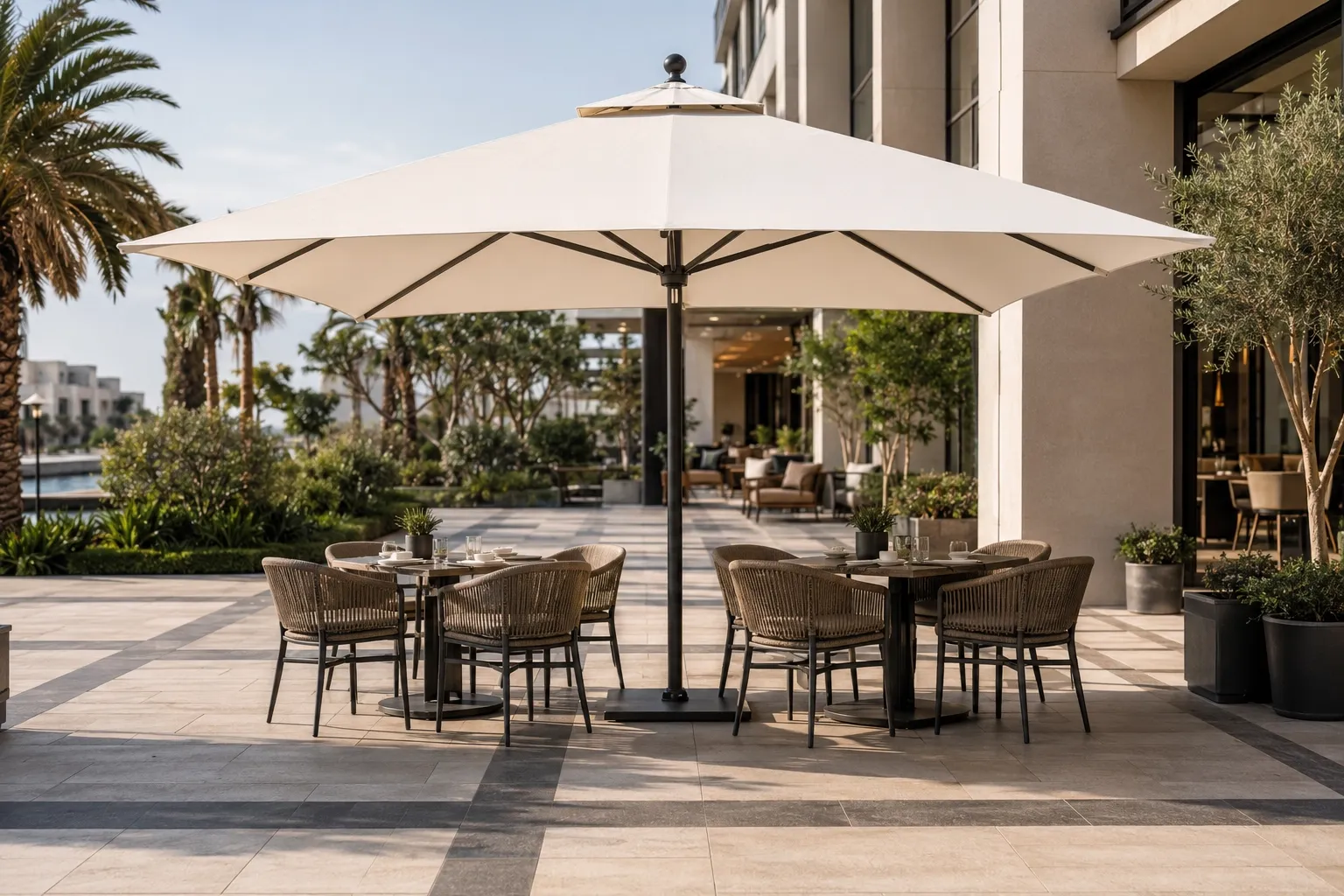
Choosing the right commercial outdoor umbrella size involves more than matching a canopy to a table. The umbrella must provide useful shade, fit the available space, maintain safe clearance, and work with the installation conditions of the project.
For hotels, restaurants, resorts, cafés, outdoor furniture brands, and commercial developments, the best size usually depends on five factors: the area to be shaded, furniture dimensions, movement around the space, sun direction, and the type of umbrella structure.
Start with the Area You Need to Shade
Measure the usable outdoor area before selecting an umbrella. Record both the length and width of the space, then identify fixed elements such as walls, columns, planters, walkways, doors, pools, and lighting.
Do not assume that the canopy dimensions equal the exact usable shade area. The actual shadow changes throughout the day according to the sun angle. A larger canopy may provide broader coverage, but its pole position, height, tilt, and orientation also affect where the shade falls.
For dining areas, measure the table and chairs while they are in use—not only when the chairs are pushed under the table.
Allow Adequate Coverage Around the Furniture
As a general starting point, the canopy should extend approximately 60–75 cm (24–30 in) beyond the edge of the table or seating area on each side.
This additional coverage helps shade seated guests as well as the tabletop. However, the required extension may be greater in locations with strong afternoon sun or where uninterrupted shade is especially important.
Typical starting points include:
- A 2.0–2.5 m umbrella for a small two-person café table
- A 2.5–3.0 m umbrella for a four-person dining table
- A 3.0–3.5 m umbrella for a six-person dining or lounge arrangement
- A 4.0 m or larger umbrella for communal tables, poolside seating, and large hospitality spaces
These are general references rather than fixed rules. Table shape, canopy shape, pole position, and local conditions should always be considered.
Match the Canopy Shape to the Layout
Round and square umbrellas work well with compact tables and individual seating groups. Rectangular umbrellas are often more efficient over long dining tables, rows of loungers, or narrow terraces.
A canopy that follows the furniture layout usually provides better coverage without occupying unnecessary space.
For repeated seating arrangements, several medium-sized umbrellas may offer more flexible coverage than one very large umbrella. Large-format umbrellas are useful when a project needs broad, continuous shade with fewer support poles.
Choose the Right Umbrella Structure
Center Pole Umbrellas
Center pole umbrellas are a practical choice for dining tables with a central umbrella hole, individual café tables, and many standard hospitality layouts. They are generally straightforward to position and available in a wide range of sizes.
The pole occupies the center of the shaded area, so the furniture must be compatible with that arrangement.
Cantilever Umbrellas
Cantilever umbrellas position the supporting mast outside the main shaded area. This leaves more usable space beneath the canopy and works well for lounge furniture, poolside seating, restaurant terraces, and layouts without a central table opening.
Because the canopy extends away from the mast, sufficient space must also be allowed for the side structure and base.
Large Commercial Umbrellas
Large commercial umbrellas are intended for wider dining zones, hotel terraces, resort spaces, and high-traffic commercial applications. Their larger canopy and heavier structure require careful consideration of access, installation, anchoring, and wind exposure.
For large-format installations, product size should be selected as part of the overall project layout rather than from table dimensions alone.
Check Height and Clearance
An umbrella needs enough clearance for guests, staff, doors, lighting, signs, and nearby structures. It should not interfere with pedestrian routes or service areas.
Check the following measurements:
- Overall umbrella height
- Clearance under the canopy edge
- Height when the umbrella is closed
- Space required during opening and closing
- Distance from walls, roofs, trees, and adjacent umbrellas
- Clearance around a cantilever mast and support arm
On restaurant terraces, make sure staff can move comfortably between tables when chairs are occupied.
Consider Sun Direction and Site Exposure
A larger umbrella does not automatically solve every shade problem. Morning and afternoon sun can enter from the side, particularly in west-facing spaces.
Review the location at different times of day when possible. The best solution may involve changing the umbrella position, using several umbrellas, selecting a cantilever model, or combining overhead shade with other design elements.
Wind exposure is equally important. Rooftops, waterfront locations, open courtyards, and elevated terraces may experience stronger or more turbulent wind than sheltered ground-level spaces.
Umbrellas should always be closed during strong winds and severe weather. Canopy size, frame construction, base weight, and anchoring method must be evaluated together. Local regulations and professional installation requirements should also be checked for commercial projects.
Plan the Base or Installation Method
The umbrella base should not be selected by canopy size alone. Its suitability depends on the umbrella structure, total dimensions, wind exposure, surface conditions, and intended use.
Common options include:
- Freestanding weighted bases
- Stone or concrete weight plates
- Mobile bases with lockable wheels
- In-ground sleeves
- Deck-mounted or surface-mounted installations
- Custom fixed-installation systems
Fixed mounting may provide a cleaner layout for permanent commercial installations, while weighted bases offer greater flexibility. Confirm the compatible base or mounting method before finalizing the umbrella size.
Think Beyond a Single Umbrella
For larger commercial spaces, prepare a simple layout showing tables, seating, walkways, umbrella positions, canopy dimensions, and pole or base locations.
This makes it easier to identify gaps in shade, prevent canopy overlap, preserve circulation routes, and estimate the total number of umbrellas required.
When several umbrellas are installed together, leave enough space for normal movement and opening. Avoid placing canopy edges so close that they can touch in changing weather conditions.
Information to Prepare Before Requesting a Quote
Providing a few project details helps a supplier recommend a more suitable umbrella size and configuration:
- Umbrella type or preferred structure
- Area or furniture dimensions
- Required quantity
- Installation location and delivery country
- Preferred canopy shape and color
- Branding or logo requirements
- Base or mounting preference
- Photos, drawings, or a basic layout of the site
Exact specifications can then be confirmed according to the product model and project conditions.
Choosing the Right Commercial Umbrella
The right commercial outdoor umbrella should provide practical shade without obstructing furniture, circulation, or surrounding structures. Start with accurate measurements, allow for coverage beyond the furniture, and consider the canopy, frame, base, and site conditions as a single, complete system.
If you are planning a hospitality, outdoor furniture, or commercial shade project, Snova Outdoor can help you review your layout and recommend suitable center-pole, cantilever, or large-format umbrella options.