
Aug 21, 2026Buying Guides
Commercial Umbrella Base Weight Guide | Buyer Tips
Learn how to choose a commercial umbrella base weight based on canopy size, umbrella structure, site exposure, surface, and installation requirements.
Commercial Umbrella Base Weight Guide: What Buyers Must Consider
Choosing the correct commercial umbrella base weight is an important part of planning a restaurant patio, hotel terrace, resort pool area, or other outdoor commercial space.
A base that is too light may not provide suitable support for the selected umbrella, while an unnecessarily large base can increase cost, occupy valuable floor space, and make daily operation more difficult.
However, there is no universal rule such as “a 3-meter umbrella always needs a certain base weight.”
The correct base depends on the complete umbrella system, including canopy size, frame structure, mast position, installation surface, site exposure, and whether the umbrella must remain movable.
Quick Answer: How Heavy Should a Commercial Umbrella Base Be?
The required base weight should follow the recommendation for the specific umbrella model and installation condition.
A center pole umbrella positioned through a dining table may require a different support system from the same-size freestanding umbrella.
A cantilever umbrella usually requires substantially more support because its canopy extends away from the mast and creates greater leverage.
Large commercial umbrellas may require fixed surface mounts, ground sleeves, engineered foundations, or other project-specific installation systems rather than a conventional portable base.
For this reason, buyers should avoid selecting a base only from canopy diameter.
1. Canopy Size Is Only the Starting Point
Larger canopies generally create greater loads on the supporting system, but canopy size alone does not determine the correct base.
For example, two 3 × 3 m umbrellas can have very different structures.
One may be a relatively straightforward center pole umbrella, while another may be a cantilever model with the entire canopy suspended away from the mast.
The second structure creates additional leverage and therefore requires a different base and mounting approach.
Canopy shape also matters. Round, square, and rectangular umbrellas distribute their dimensions differently, especially when wind reaches the canopy from different directions.
When requesting a base recommendation, provide the exact umbrella model rather than only saying “3-meter umbrella.”
2. Center Pole and Cantilever Umbrellas Need Different Support
Center Pole Umbrellas
A center pole umbrella transfers the canopy load downward through a mast located beneath the center of the canopy.
In restaurant applications, the pole may pass through a dining table and into a weighted base underneath.
The table can help control movement, but it should not automatically be considered a replacement for the required base.
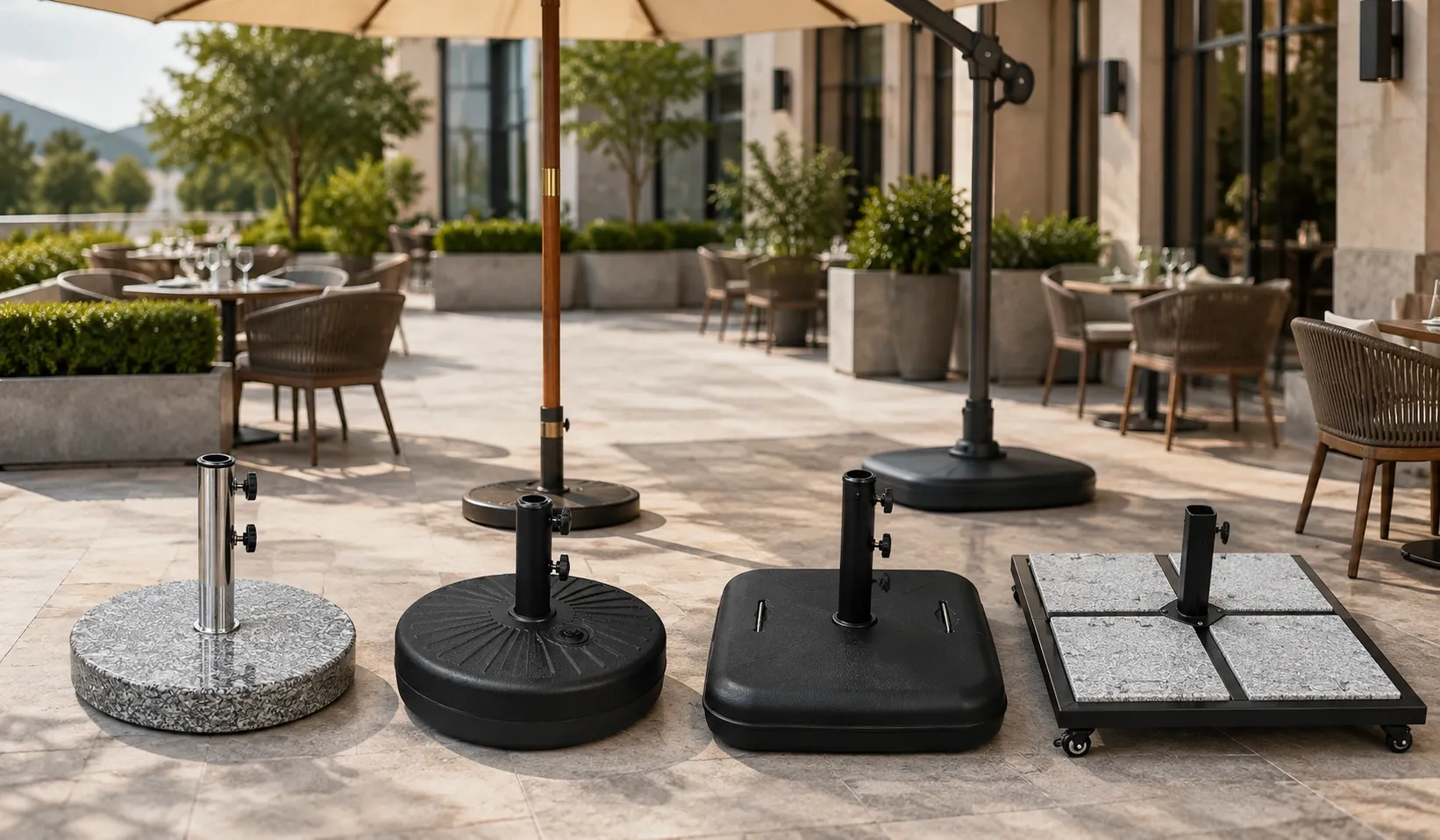
Freestanding center pole umbrellas may use:
- Steel plate bases
- Stone or concrete bases
- Fillable bases
- Wheeled commercial bases
- Surface mounts
- Ground sleeves
Cantilever Umbrellas
A cantilever umbrella places the mast beside the shaded area.
Because the canopy projects outward from the side mast, the structure creates significantly more leverage on the base.
Commercial cantilever systems may therefore use large steel plates, multiple ballast sections, heavy mobile bases, or fixed mounting systems.
The base should be treated as part of the complete cantilever system rather than as a separate accessory selected after the umbrella.
3. Wind Exposure Changes the Requirement
A commercial umbrella installed inside a protected courtyard is not exposed to the same conditions as an umbrella on an open rooftop, coastal terrace, pool deck, or exposed restaurant patio.
Important site factors include:
- Typical local wind conditions
- Sudden gusts
- Surrounding buildings
- Open coastal exposure
- Rooftop height
- Trees and walls
- Wind channels between buildings
- Whether umbrellas are attended by staff
A heavier base does not make an umbrella safe to leave open in severe weather.
Commercial operators should still follow the opening and closing recommendations for the selected model and establish a clear staff procedure for changing weather conditions.
If wind performance is critical, ask for model-specific information rather than relying on general descriptions such as “wind resistant.”
4. Installation Surface Matters
The same umbrella may require different support depending on where it is installed.
Concrete or Paved Terraces
Freestanding bases are convenient when permanent drilling is not allowed.
For projects where fixed mounting is permitted, a surface-mounted plate may reduce the footprint compared with a large movable base.
Timber Decks
The visible decking boards are not necessarily the structural support.
Before using a fixed mount, the underlying construction should be reviewed to determine whether reinforcement or another mounting method is required.
Rooftops
Rooftop projects require additional attention to wind exposure, waterproofing, structural loading, access, and emergency closing procedures.
Ground Installation
Ground sleeves or foundations can provide a clean commercial installation, particularly for large umbrellas, but they need to be coordinated before paving or landscaping is completed.
5. Base Weight vs Fixed Mounting
For many commercial projects, the real decision is not simply:
“How heavy should the base be?”
It is:
“Should this umbrella be movable or permanently mounted?”
Movable weighted bases provide flexibility. Restaurants can adjust furniture layouts, store umbrellas seasonally, or reposition shade when necessary.
Fixed mounting can reduce floor obstruction and may be more appropriate for larger commercial umbrellas or permanent hospitality installations.
The decision should consider:
- Required mobility
- Guest circulation
- Base footprint
- Installation surface
- Wind exposure
- Seasonal storage
- Cleaning access
- Project construction stage
Commercial Umbrella Base Buyer Checklist
Before ordering, confirm:
- Umbrella type
- Exact model
- Canopy dimensions
- Mast size
- Center pole or cantilever structure
- Recommended base or mounting system
- Installation surface
- Indoor, courtyard, rooftop, coastal, or open exposure
- Whether the umbrella must be movable
- Base dimensions
- Base weight
- Wheels if required
- Ground sleeve or surface mount options
- Packing dimensions
- Quantity
- Delivery destination
This information allows the umbrella and support system to be evaluated together.
Conclusion
There is no single commercial umbrella base weight that works for every outdoor umbrella.
Canopy size matters, but umbrella structure, leverage, site exposure, mounting surface, mobility requirements, and manufacturer recommendations are equally important.
Center pole umbrellas may work with relatively compact weighted bases or table-and-base combinations, while cantilever and large commercial umbrellas often require substantially stronger support or fixed installation.
The safest and most practical approach is to select the umbrella first, then specify a compatible base or mounting system as part of the complete commercial shade solution.
Need Help Matching an Umbrella With the Right Base?
Send Snova Outdoor your umbrella type or preferred model, canopy size, quantity, installation surface, project location, and whether the umbrellas need to remain movable.
We can recommend suitable commercial umbrella and base configurations and prepare a project-based quotation for your restaurant, hotel, resort, outdoor furniture, or commercial shade project.
How heavy should a base be for a commercial patio umbrella?
There is no universal weight. It depends on the umbrella model, canopy size, structure, site exposure, and installation method.
Do cantilever umbrellas need heavier bases than center pole umbrellas?
Generally, cantilever umbrellas require greater support because the canopy projects outward from the mast, creating additional leverage.
Does a patio table replace the umbrella base?
Not necessarily. In most commercial installations, the pole passes through the table and continues into a compatible base below.
Is a heavier umbrella base always safer?
No. Correct model compatibility, installation, wind exposure, and operating procedures are also important. A heavier base does not mean an umbrella should remain open during severe weather.