Aug 7, 2026Buying Guides
How Cantilever Umbrellas Work | Commercial Buyer Guide
Learn how cantilever umbrellas work, including offset structure, rotation, tilt, bases, commercial applications, and key specifications for buyers.
How Cantilever Umbrellas Work: Offset Structure, Movement, and Support
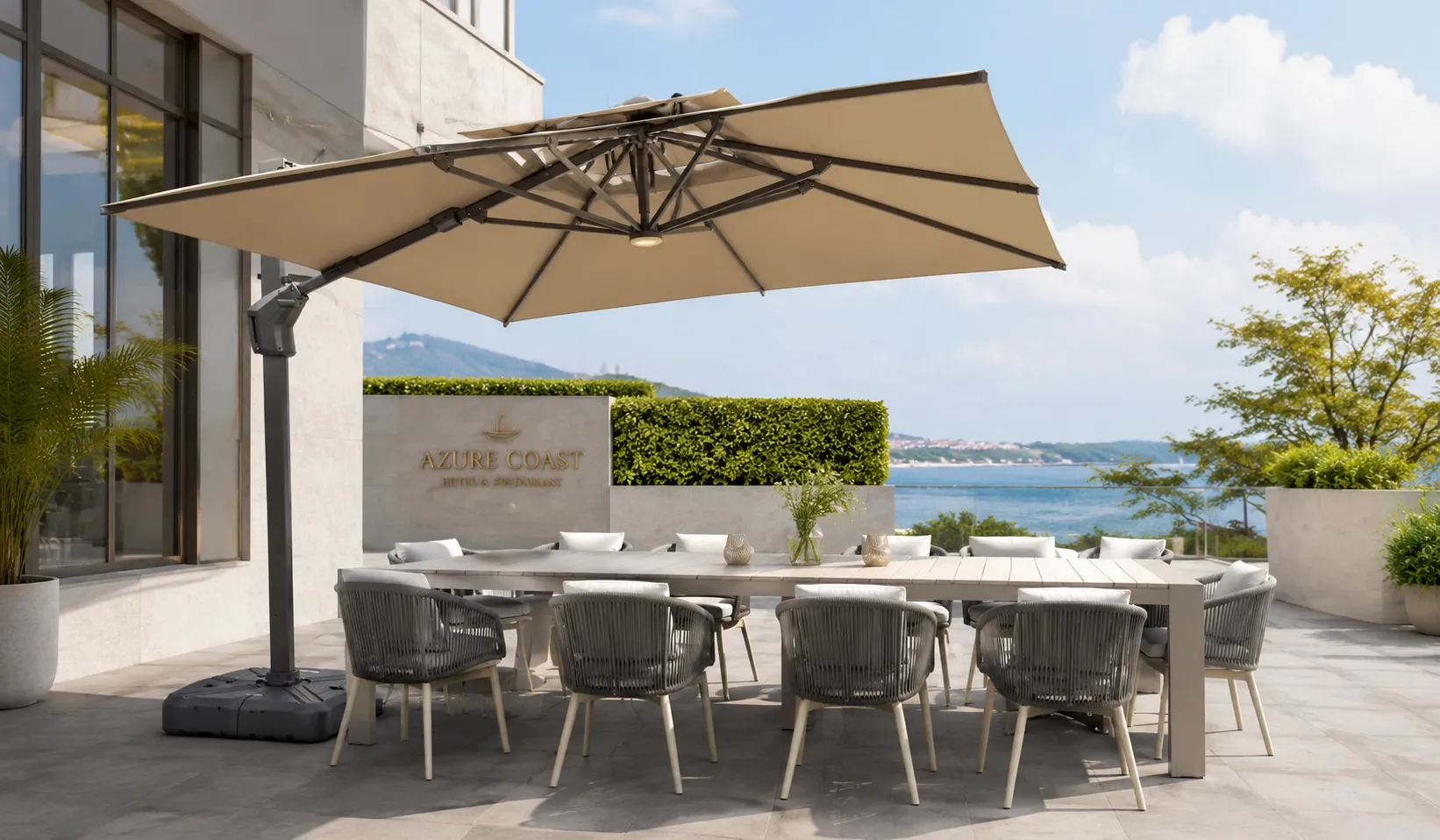
A cantilever umbrella, also called an offset umbrella or side-post umbrella, supports the canopy from a mast positioned beside the shaded area rather than directly underneath the center.
This design keeps the space beneath the canopy more open, which is why commercial cantilever umbrellas are commonly used around hotel pools, restaurant terraces, outdoor sofas, lounge furniture, and large dining tables.
Unlike a standard center pole umbrella, however, the offset structure creates more leverage on the supporting mast and base. For commercial buyers, choosing the right cantilever umbrella therefore requires looking at the complete system—not only the canopy size.
Quick Answer: How Does a Cantilever Umbrella Work?
A cantilever umbrella uses a vertical side mast, horizontal or angled supporting arm, ribs, hubs, and a base or fixed mounting system to hold the canopy away from the main pole.
When the umbrella opens, the supporting arm positions the canopy over the seating area while the mast remains to one side.
Depending on the model, the umbrella may also include:
- 360-degree rotation
- Vertical or lateral tilt
- Crank opening
- Handle adjustment
- Foot-pedal rotation
- Locking positions
These functions allow the shade position to change without moving the entire umbrella.
The offset design provides more usable space under the canopy, but it also means the mast, arm, frame connections, and base must work together as one structural system.
1. Main Parts of a Cantilever Umbrella
Side Mast
The mast is the main vertical support.
Commercial cantilever umbrellas commonly use aluminum because it combines relatively low weight with corrosion resistance and can be finished in powder coating or wood-look finishes.
Buyers should compare more than the outside appearance. Important specifications include mast profile, wall thickness, finish, connection points, and the overall frame design.
Supporting Arm
The supporting arm extends from the mast toward the center of the canopy.
Because the canopy hangs away from the pole, this arm carries significant leverage. Its profile, reinforcement, joints, and connection to the mast are therefore important parts of the structure.
Ribs and Hubs
The ribs support the canopy fabric and connect to the central hub.
Depending on the design, commercial umbrellas may use aluminum, steel, fiberglass, or combinations of these materials.
The rib system should keep the canopy correctly tensioned while allowing the umbrella to open and close smoothly.
Canopy
The canopy provides the actual shaded area.
Commercial projects commonly consider factors such as:
- Solution-dyed polyester or acrylic fabric
- Fabric weight
- UV protection
- Colorfastness
- Water resistance
- Replaceable canopy construction
- Custom color or logo printing
The canopy should be evaluated together with the frame rather than as a separate decorative component.
2. How Rotation and Tilt Functions Work
One reason cantilever umbrellas are popular in hospitality projects is their adjustability.
360-Degree Rotation
Some models allow the complete upper structure to rotate around the mast.
A foot pedal, locking pin, or other mechanism releases the rotation system so the canopy can be repositioned toward another seating area.
This can be useful for hotel pool decks and restaurant terraces where the sun direction changes during the day.
However, the full rotation area must remain clear of walls, trees, lighting fixtures, and adjacent umbrellas.
Tilt Adjustment
Tilt systems allow the canopy angle to change.
Depending on the model, this may be a vertical tilt, lateral tilt, or multi-position adjustment.
Tilting can help extend shade earlier or later in the day, but it should not be treated as a substitute for correct umbrella positioning and sizing.
3. Why Cantilever Umbrellas Need a Suitable Base
Because the canopy is positioned away from the mast, a cantilever umbrella creates greater leverage than a comparable center pole umbrella.
For this reason, the base is a critical part of the system.
Common commercial options include:
- Cross bases with ballast tiles
- Heavy steel plate bases
- Stone or concrete ballast
- Wheeled bases
- Surface-mounted plates
- In-ground mounting systems
There is no single base weight suitable for every cantilever umbrella.
The correct solution depends on canopy dimensions, frame structure, installation surface, site exposure, and the manufacturer’s recommendations for the selected model.
For fixed commercial installations, the mounting condition should be reviewed before ordering.
4. Where Are Cantilever Umbrellas Best Used?
Hotel and Resort Pools
Cantilever umbrellas are especially useful beside sun loungers because the supporting pole can remain behind or beside the furniture.
This keeps the shaded area more open and reduces obstruction between loungers.
Restaurant Terraces
For large dining tables without umbrella holes, an offset umbrella can provide shade without placing a center pole between guests.
Restaurants should still consider the base footprint and staff circulation before choosing the final position.
Outdoor Lounge Areas
Sofas, sectional furniture, and coffee-table layouts often benefit from cantilever umbrellas because the furniture can sit directly beneath the canopy.
Villas and Hospitality Projects
Cantilever systems are also frequently specified where buyers want a cleaner, more premium outdoor appearance combined with adjustable shade.
5. What Commercial Buyers Should Check Before Ordering
Before comparing quotations, confirm:
- Canopy shape and size
- Mast and arm material
- Frame profile and wall thickness
- Rib material and quantity
- Opening mechanism
- Rotation range
- Tilt functions
- Fabric specification
- Base or fixed mounting method
- Closed dimensions
- Operating clearance
- Replacement canopy availability
- Spare parts
- Logo or custom color requirements
- Packing dimensions
- Quantity and delivery country
Two cantilever umbrellas with the same stated size can have very different frame structures, mechanisms, fabrics, bases, and serviceability.
For commercial projects, the lowest unit price should therefore not be the only purchasing criterion.
Conclusion
A cantilever umbrella works by supporting the canopy from a side mast and extending it over the shaded area through an offset arm structure.
Its main advantage is the open space beneath the canopy, making it particularly suitable for hotel pools, restaurant terraces, outdoor lounges, and hospitality projects.
At the same time, the offset structure places greater importance on the mast, supporting arm, connections, base, and operating system.
For a commercial project, send Snova Outdoor your preferred canopy size, quantity, application, furniture layout, delivery country, and customization requirements. We can recommend suitable cantilever umbrella configurations and prepare a project-based quotation.
What is the difference between a cantilever umbrella and an offset umbrella?
In most commercial patio applications, the terms describe the same general structure: the main support pole is positioned beside the canopy rather than directly underneath it.
Are cantilever umbrellas suitable for restaurants?
Yes. They are particularly useful for large dining tables, lounge seating, and layouts where a center pole would interfere with furniture or guest circulation.
Do cantilever umbrellas need heavier bases?
Cantilever structures generally place greater leverage on the base than center pole umbrellas. The required base or mounting system depends on the specific model, canopy size, installation surface, and site conditions.
Can a cantilever umbrella rotate?
Many commercial models offer 360-degree rotation, although the mechanism and number of locking positions vary by design.