Aug 10, 2026Buying Guides
What Is a Large Commercial Umbrella? Sizes, Structures, and Applications
Learn what a large commercial umbrella is, common structures, sizing factors, applications, installation needs, and what buyers should check before ordering.
What Is a Large Commercial Umbrella? Sizes, Structures, and Applications
A large commercial umbrella is an outdoor shade structure designed to cover a wider seating, dining, or activity area than a standard patio umbrella.
These umbrellas are commonly used by restaurants, hotels, resorts, commercial courtyards, hospitality projects, and other outdoor spaces where broader shade coverage, stronger supporting structures, and project-based installation are required.
There is no single canopy dimension that automatically defines an umbrella as “large commercial.” Instead, buyers should consider the complete system: canopy size, mast and rib structure, opening mechanism, mounting method, site exposure, furniture layout, and how the umbrella will be operated every day.
For commercial projects, selecting the right large umbrella should therefore begin with the site rather than simply choosing the biggest available canopy.
Quick Answer: What Makes an Umbrella a Large Commercial Umbrella?
Compared with a conventional café or market umbrella, a large commercial umbrella generally provides greater shade coverage and uses a more substantial structural system to support the larger canopy.
It may feature a reinforced center mast, heavier rib profiles, additional ribs, a telescopic closing system, a cantilever structure, or even multiple canopies supported by one system.
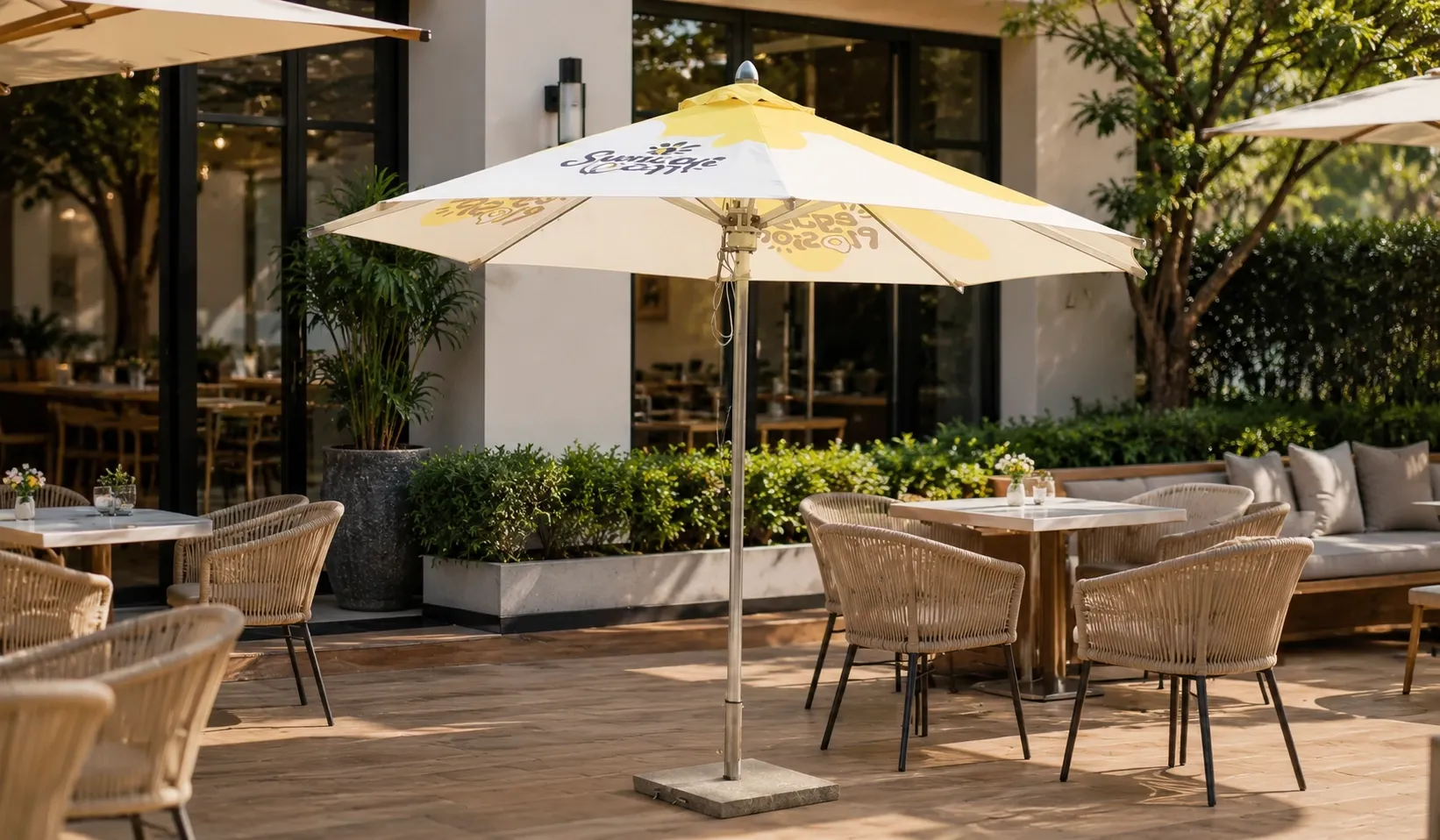
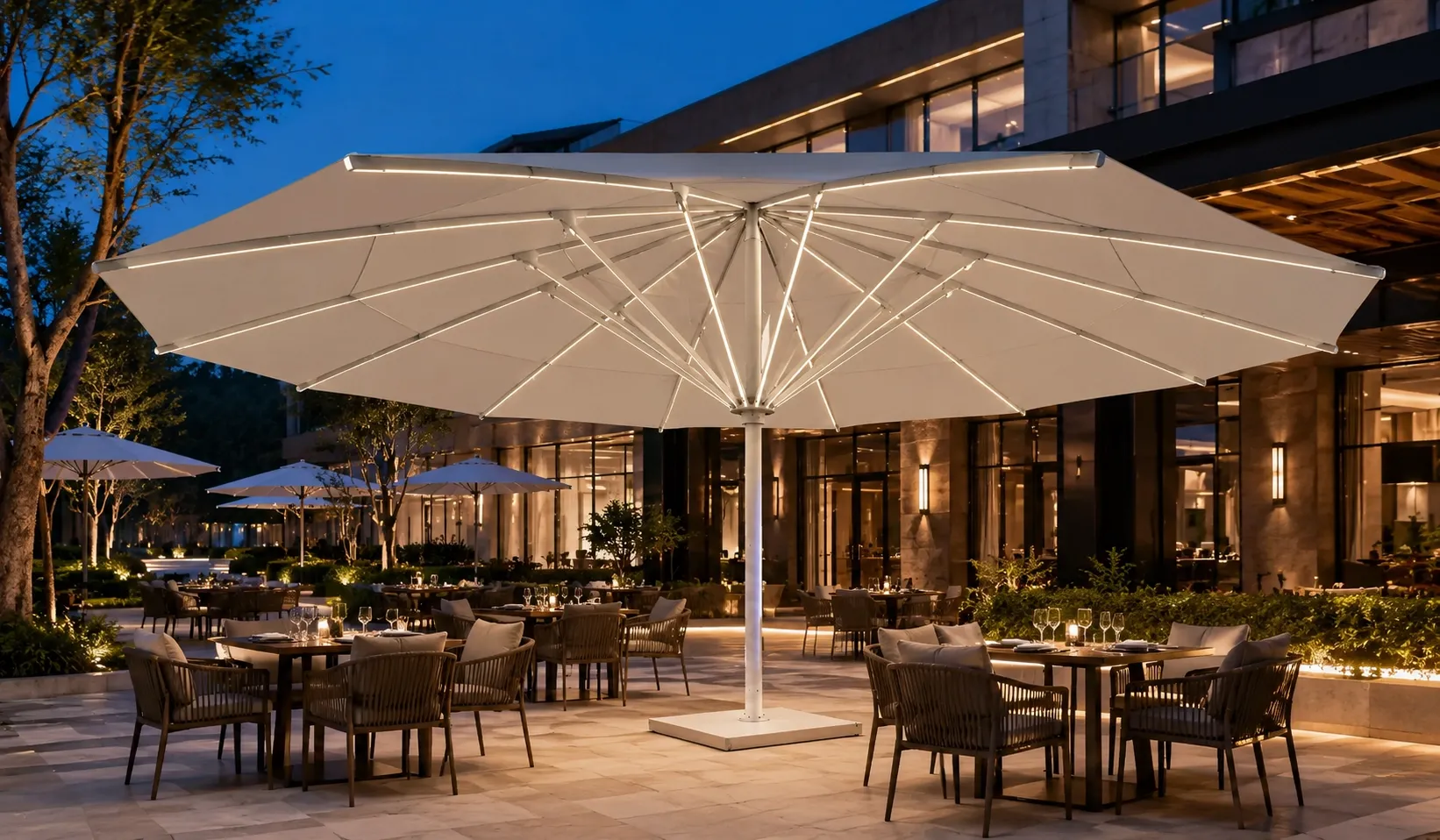
Large commercial umbrellas may also offer project-oriented options such as fixed mounting, replaceable canopies, custom fabrics, integrated lighting, branding, and specialized opening systems.
The exact configuration depends on the application and the selected model.
1. Common Types of Large Commercial Umbrellas
Large Center Pole Umbrellas
A large center pole umbrella uses a vertical mast directly beneath the center of the canopy.
This structure provides a relatively direct load path and can work well for restaurant terraces, hotel courtyards, outdoor dining areas, and large seating zones where the central mast can be incorporated into the furniture layout.
Compared with smaller market umbrellas, large center pole models may use wider mast profiles, reinforced hubs, additional ribs, and more substantial mounting systems.
Some models may also incorporate telescopic operation, allowing the canopy to close upward and away from furniture rather than folding directly down around the mast.
Large Cantilever Umbrellas
Large cantilever umbrellas position the main support mast beside the shaded area.
This keeps the space underneath the canopy more open, which can be valuable for lounge seating, large dining tables, poolside furniture, and premium hospitality layouts.
Because the canopy projects away from the mast, the supporting arm, joints, base, and installation system become especially important.
Multi-Canopy and Double-Sided Systems
Some large commercial shade systems use one main mast to support two or more canopy sections.
This configuration can provide wide coverage while reducing the number of support posts within the seating area.
Double-sided umbrellas are particularly useful where two adjacent dining or lounge zones need shade but the project designer wants to maintain more open space between furniture groups.
2. How Large Should a Commercial Umbrella Be?
The best size depends on the area that actually needs shade.
A buyer should begin with the dimensions of the dining, lounge, or circulation zone rather than selecting an umbrella only by its catalogue size.
For example, a large restaurant terrace may need several coordinated umbrellas rather than one extremely large canopy. Multiple units can provide greater layout flexibility, easier zoning, and more manageable replacement or maintenance.
By contrast, a hotel courtyard or open resort space may benefit from fewer large-format umbrellas when minimizing support posts is a design priority.
Sun direction also matters. A canopy does not create the same usable shade footprint throughout the entire day, so the furniture arrangement and peak operating hours should be considered together.
Your existing umbrella sizing guide can support this decision process and should be internally linked from this section.
3. Where Are Large Commercial Umbrellas Used?
Large commercial umbrellas are particularly suitable for hospitality and project environments where shade is part of the overall space design.
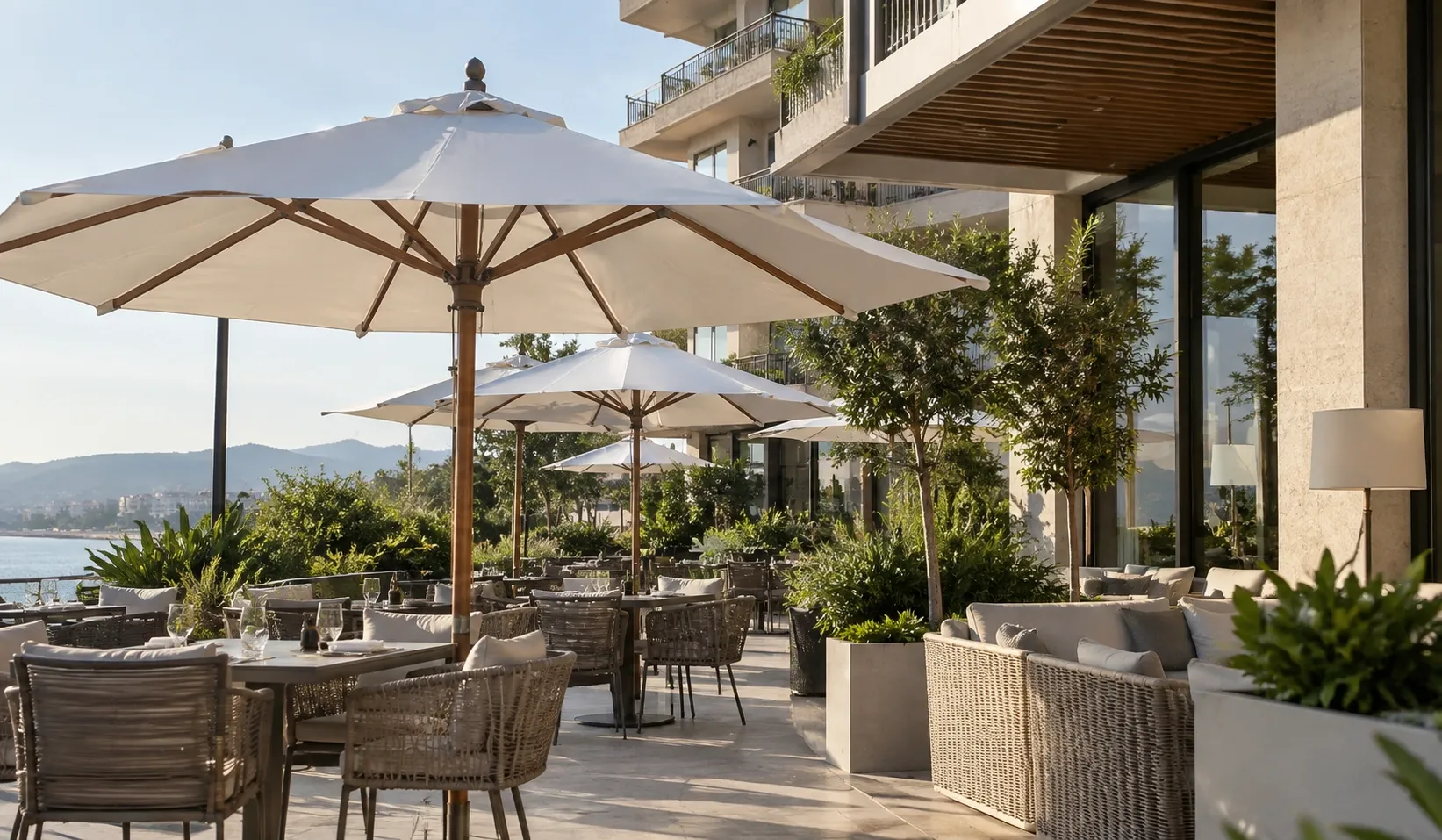
Restaurants can use them to cover several dining tables or larger communal seating areas. Hotels and resorts may use them around courtyards, pool terraces, outdoor restaurants, lounge zones, and guest gathering spaces.
They can also be considered for commercial plazas, outdoor furniture projects, cafés with large terraces, clubhouses, and other high-traffic outdoor environments.
The important point is that the umbrella should support the layout rather than interfere with it. Mast position, canopy height, base footprint, circulation paths, doors, landscaping, lighting, and adjacent umbrellas all need to be reviewed before final placement.
4. Installation and Wind Exposure Need More Attention
As canopy size increases, installation becomes more important.
A large umbrella may use a weighted commercial base, surface-mounted plate, ground sleeve, or another fixed installation method depending on the model and project conditions.
Buyers should not assume that a generic base-weight recommendation applies to every large umbrella.
Site conditions such as open exposure, coastal locations, rooftops, surrounding buildings, installation surface, and local weather patterns can affect the appropriate mounting solution and operating policy.
A product’s structural specification should also not be interpreted as permission to leave an umbrella open during severe weather. Commercial operators should have clear procedures for closing umbrellas when conditions exceed the limits recommended for the selected model.
5. What Should Commercial Buyers Check Before Ordering?
Before requesting a final quotation, confirm:
- Canopy shape and dimensions
- Total umbrella height and clearance
- Mast, rib, hub, and supporting-arm specifications
- Frame material and finish
- Fabric type, color, and performance requirements
- Opening and closing system
- Rotation or tilt functions where applicable
- Base, ground sleeve, or fixed mounting requirements
- Installation surface and site exposure
- Integrated lighting if required
- Replacement canopy and spare-part availability
- Logo and custom branding requirements
- Packing dimensions and transport limitations
- Quantity, delivery country, and project schedule
Large umbrellas can create oversized shipping packages, so freight and access to the final installation area should be reviewed early rather than after production is complete.
Conclusion
A large commercial umbrella is more than an oversized patio umbrella.
It is a complete outdoor shade system in which canopy dimensions, frame structure, installation, furniture layout, site exposure, operation, and maintenance must work together.
Large center pole umbrellas can provide straightforward wide-area coverage, while large cantilever and multi-canopy systems can keep more usable space free from supporting posts.
The best solution depends on the actual project rather than canopy size alone.
Planning a restaurant, hotel, resort, or large outdoor shade project? Send Snova Outdoor your site dimensions or floor plan, required shade area, preferred umbrella style, quantity, installation surface, delivery country, and customization requirements. We can review the application and recommend suitable large commercial umbrella configurations for your project.